Sirens

Siren Song

This is the one song everyone
would like to learn: the song
that is irresistible:

the song that forces men
to leap overboard in squadrons
even though they see beached skulls

the song nobody knows
because anyone who had heard it
is dead, and the others can’t remember.
Shall I tell you the secret
and if I do, will you get me
out of this bird suit?
I don’t enjoy it here
squatting on this island
looking picturesque and mythical
with these two feathery maniacs,
I don’t enjoy singing
this trio, fatal and valuable.

I will tell the secret to you,
to you, only to you.
Come closer. This song

is a cry for help: Help me!
Only you, only you can,
you are unique

at last. Alas
it is a boring song
but it works every time.

Margaret Atwood

The Grand Medieval Bestiary

I love books. I also love history. Combine the two subjects and you have my next favorite thing after Paganism. Of course, my job in the real world is to buy books and sometimes I get to buy some really cool things.

Today we received The Grand Medieval Bestiary.

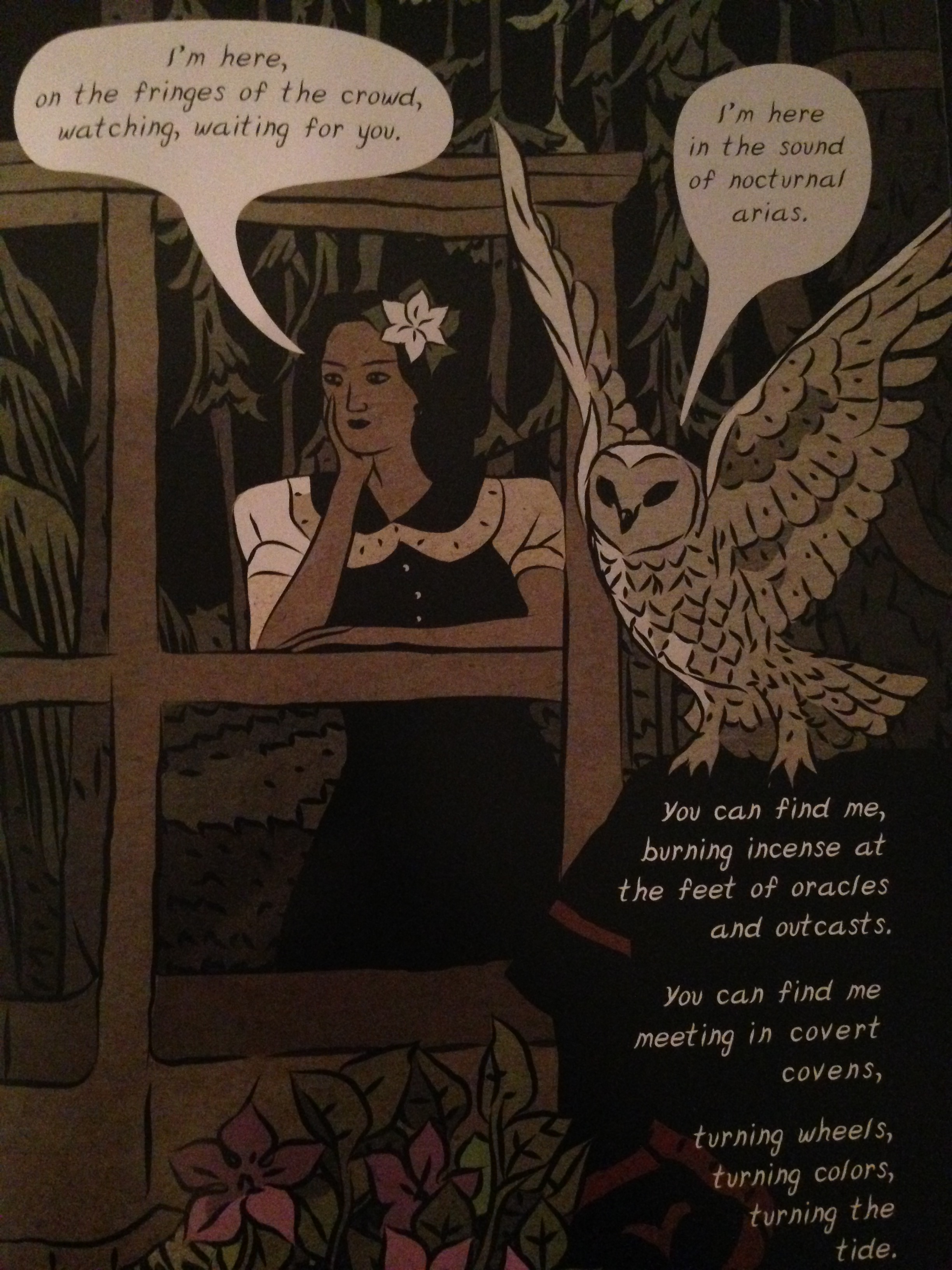
Bestiaries are really fascinating. They were Medieval compendiums of animals that cataloged each animal’s characteristics and the moral lessons and symbolism associated with each beast. In the Medieval, Christian world, the Word of God created everything and therefore, everything in it was a reflection of the Word of God. A lot of Pagan lore and mythology slipped into this and a great deal of the stories we have today were kept in these bestiaries. In what was a time of great darkness, these books shine through the years as the works of art and lore that they are. I find these to be particularly compelling books, that ultimately show the power of words and through them, magic.

Here are some pictures from this particular modern Bestiary.

This one amuses me greatly. I really want to start singing “Bad Horse”.

IMG_1416

IMG_1419

Actaeon’s transformation after he has come across Artemis bathing.

IMG_1421

IMG_1422

IMG_1427

IMG_1429

IMG_1431

IMG_1433

IMG_1434

IMG_1438

IMG_1439

IMG_1440

IMG_1441

The Common House Cat…also possibly some foot fetishists…

IMG_1442

IMG_1444

IMG_1445

IMG_1446

IMG_1447

IMG_1448

IMG_1449

IMG_1450

IMG_1451

IMG_1455

I would hate to have this monkey as a teacher.

IMG_1456

IMG_1457

IMG_1458

IMG_1461

IMG_1463

IMG_1464

IMG_1466

IMG_1469

IMG_1471

IMG_1473

IMG_1475

IMG_1477

IMG_1479

These were just a few of my favorites. If you want to know more about Bestiaries, check out:

The Medieval Beastiary, Animals in the Middle Ages

The Medieval Beastiary

“Medieval Bestiaries and the Birth of Zoology” 
by Aura Beckhöfer-Fialho

Books of Beasts in the British Library: the Medieval Bestiary and its context

Medieval Bestiary

If you want to read more about Medieval books, look at:

The Last of the Great Chained Libraries

The Evolution of the Medieval Book

The Art of the Book in the Middle Ages

The Medieval Library

Beltane Chase

When I think of Beltane, I think about fire. While most sabbats call to me in different ways, most of them slide over me with the coming of the nighttime sky and the Lady’s light.

Not Beltane. Beltane always holds fire in its wild dance and of course, that’s what it’s all about.

The fire of passion, sex, creativity, love, art…

Many couples dance around and over bonfires and there is a whole host of traditional practices associated with this particular holiday. One of the most traditional ways to celebrate this holy day is a reenactment of the marriage of the Young God to the May Queen, which is exactly what the Beltane Fire Society in Scotland does.

Through an immense performance full of pageantry and acrobatics, the Beltane Fire Society tells the story of the conception of summer through the marriage of the May Queen and the Green Man.

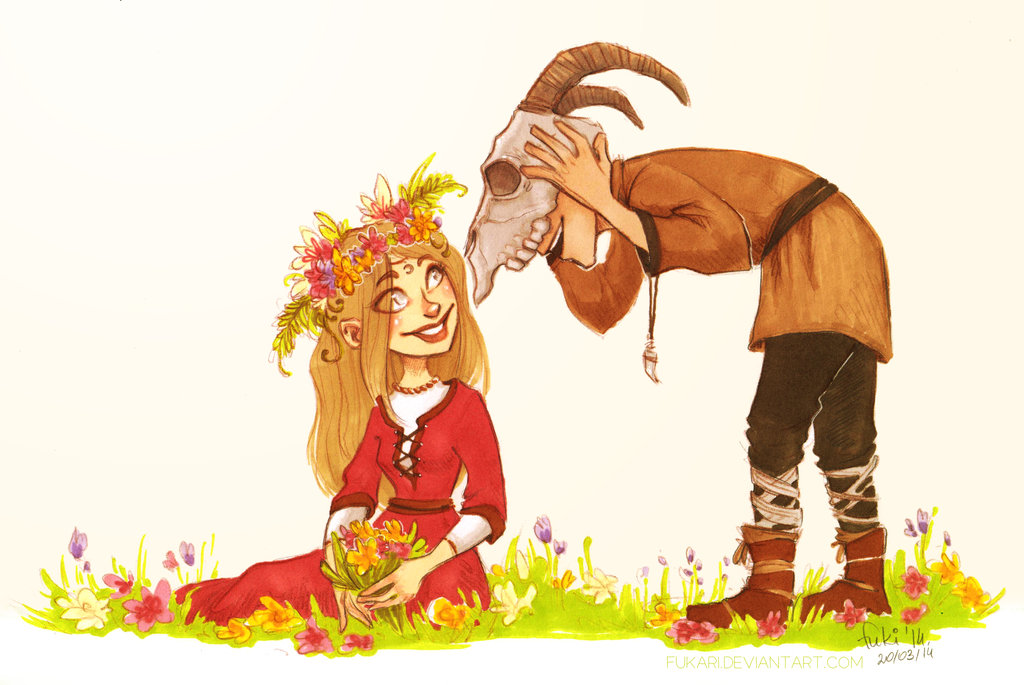
Here in New Orleans, a friend of mine is determined to make it to the official Beltane Fire Society event and participate. But, until she can, she has decided to create her own version here. And so on Sunday evening, we all gathered and participated in the Wyld Fire Beltane Hunt in our own version of the Young God’s hunt through the forest to find and capture the May Queen.

I was honored to be crowned the May Queen and spent a tense hour of hiding in the forest as night fell, with my handmaidens holding off eager hunters with riddles. While I was eventually “captured” and “wed”, being chased through the forest in the dark put a completely different spin on this ritual for me.

The hunter who was crowned May King would certainly not have been my choice. As a follower of a Goddess who is torn between two lovers, lovers of duty and choice, I finally understood how suspended she is in that moment of change. There is still choice in the inevitable, but it is not a choice that most of us who are lucky enough to live in a modern era full of personal freedom can easily understand.

As a modern Pagan, it is often easy to overlook the primitive, vital nature of the things we’re celebrating. As I ran down a dark trail that I could barely see, with several large, strange men behind me, my heart was racing with adrenaline and fear. Even knowing that none of these men actually meant to hurt me, or force me, the hunt took on its true nature.

Later, after recreating the “hunt” around the fire, and dancing and celebrating, I bestowed kisses and blessings on anyone who asked me to as the embodiment of the May Queen.

For all of the hard work and planning that went into this event, the ritual itself was fairly simple. But the emotions and energy it brought up certainly weren’t. This ritual changed my perspective on what this time of year means and I hope in the future I can remember to search for the more visceral energy the runs beneath our cleaned up, modern rites. It’s this energy that we’re celebrating after all.

For further reading, check out Rynn Fox’s articles on The Beltane Fire Society:

Pomp, Pageantry & Paganism: Beltane Fire Society Rekindles Celtic Quarter Holiday Celebrations in Edinburgh, Scotland

Ancient Tradition, Rekindled: How the Beltane Fire Society Reinvigorated Celtic Quarter Holiday Celebrations in Edinburgh, Scotland

Bringing Legend to Life: How the Beltane Fire Society Creates Ritual for 6,000 People

And Simon Croft’s Beltane Fire Festival

*All pictures were taken from the Wyld Fire Beltane Hunt website

International Pagan Coming Out Day

Today is the official date for the International Pagan Coming Out Day. “IPCOD is a not-for-profit organization working to achieve greater acceptance and equity for Pagans at home, at work, and in every community.” I think it’s vitally important that we support groups like this that work for acceptance within our community. I’m lucky enough to live somewhere where being openly Pagan is not usually an issue, but even here in New Orleans, things happen.

Last summer I was in the midst of cleaning my house. Wearing a pair of short shorts, rubber gloves and with my hair a crazy, frizzy mess, I hauled the trash out. As I was opening my trash can up, I heard someone walking down the street. A huge man decked out in all sorts of gang paraphernalia had just turned around the corner. At that point we lived in a pretty bad neighborhood. Just down the block, a gang regularly hung out and probably did a good bit of business. They left me alone, they knew that I belonged in the neighborhood.  I left them alone in turn. We even, on occasion, gave each other a friendly, neighborly nod and acknowledgment. Apparently, some of this might have been because I am a witch.

This huge man, who I had never seen before and who I would not have wanted to have met in a dark ally late at night, took one look at me and crossed the street. Keeping me in his sight the whole time, he threw hex signs at me and hissed. All I could do at that point was smile and wave.

While this particular anecdote is simply amusing and nothing bad happened, I think it illustrates the type of fear that still persists in our overall society about Pagans and Witches. I made the decision a long time ago that I would be openly who I am. If a job doesn’t want me because I am openly Pagan, that is not a job for me. But other people aren’t so lucky.

So what are things that you can do to help those who aren’t out?

Just be yourself! Be open and approachable. Talk about your gatherings and holidays. Don’t hide being Pagan. Many of my coworkers have asked me a lot of questions about what I do and what Paganism is about. They know me, I’m not scary or intimidating. Be an advocate, as the IPCOD organization calls it.

You can also support your local Pagan community. Whether or not you have your own group or coven, there are usually groups that bring the entire local Pagan community together. In New Orleans, we have a meetup group. Don’t have a group like this? Start one!

Many cities also put together Pagan Pride Days through The Pagan Pride Project, which work to introduce the Pagan community to the larger community and promote acceptance and education. The New Orlean’s Pagan community is doing one this fall. Get involved and help out!

If you’re out, take a moment today to remind people that it is OK, that we can be openly Pagan and not be afraid. There is still a lot hate and intolerance in the world. It is only through standing up and saying “Yes, I am different and that’s OK” that we can start to change this and make it better. Some of us aren’t lucky enough to be safely out as a Pagan, use today as an opportunity to help change that. You never know when telling someone that you’re Pagan will make a difference.

My name is Lauren. I am a Pagan. I am proud to be so!

*If you want to help us raise money for the Greater New Orleans Pagan Pride Day 2013, check out our Indiegogo campaign found here!

An Auspicious Day for May Wine

I always feel bad for the dragon.

I always feel bad for the dragon.

I just wanted to wish everyone a Happy St. George’s Day. Not for Saint George, who I don’t particularly care for, but because St. George’s Day was the Day that Edward the Third announced the creation of the Order of the Garter in 1348. Some say that The Order of the Garter was created to protect England’s witches. If you want to read more about that, go here.

It is also supposedly the day that Brian Boru defeated the Vikings at Clontarf and died.  (Let us weep a few tears in memory).

Did anyone else read these books? I know they're terrible, but I love them.

Did anyone else read these books? I know they’re terrible, but I love them.

Also, William Shakespeare was born.

A day like today definitely calls for some May Wine…never too early to start with these sorts of things! (Traditionally this is made for May Day or Beltane, but…we’re almost there, right?)

May Wine Recipe:

1 bottle Riesling

1/2 cup dried Woodruff

1 cup diced strawberries

In a pitcher, combine the bottle of wine and the woodruff. Let sit for an hour and then add in the strawberries. Serve.

A Green Ribbon and a Few Beheadings

When I was little I owned the book In a Dark, Dark Room and Other Scary Stories by Alvin Schwartz. (This might explain some of my weirdness these days, I mean…seriously, who gives a little kid a book like this? *Sigh* Fine, fine, fine…the same parents that read the Lord of the Rings books and Louis Lamour to a four year old, but…still!)

One of the stories in it has stuck with me ever since.

The story of Jenny and her green ribbon is not particularly scary, it is however, extremely disturbing. Can you imagine living with someone whose head is held on with only a green ribbon? And why green for that matter?

It was fashionable after the French Revolution to wear a red ribbon around your neck to mark where the guillotine would have cut (combined with a short, choppy hairstyle that emulated those given to the victims of Madame Guillotine).

But there is also a long tradition of talking heads throughout mythology.

Odin carries Mimir’s head around with him after Mirmir is beheaded during the Aesir-Vanir War. Mimir, who was known for his knowledge and wisdom, continues to advise Odin.

Bran from the Mabinogion is another one. After the war with “Ireland”, when Bran has been mortally wounded, he asks his men to cut his head off and he continues to entertain them for eighty years. After they return to Wales, and leave the hall where they’ve been hanging out for all of that time to keep away the grief that the war caused them, they bury his head on the White Hill facing towards France. It is said that while Bran’s head is buried, England will be protected. In some myths, King Arthur dug Bran’s head up and declared that he would thereafter be the protector of England.

And that was how victory, such as it was, was [won] to the men of the Island of the Mighty. [But] the victory from that was no more than the escape of seven men, [along] with Bendigeidfran wounded in his foot with a poisoned spear. These were the seven men who escaped: Pryderi, Manawydan, Glifieu Eil Taran, Taliesin and Ynawg, Gruddieu son of Muriel and Heilyn son of Gwyn the Old.

And then Bendigeidfran ordered the severing of his head.

‘Take the head’ said he ‘and bring it to the White Hill in London, and bury it with its face towards France. And you will be on the road a long time. In Harlech you will be seven years in feasting, the birds of Rhiannon singing to you. The head will be as good company to you as it was at its best when it was ever on me. And you will be at Gwales in Penfro for eighty years. Until you open the door facing Aber Henvelen on the side facing Cornwall, you will be able to abide there, along with the head with you uncorrupted. But when you open that door, you will not be able to remain there. You will make for London and bury the head. Cross over to the other side.’

Then they cut off his head and with the head they set out to the other side: these seven men with Branwen with them as the eighth.

Sir Gawain and the Green Knight also comes to mind. This story takes place in King Arthur’s court. Before feasting, King Arthur likes to be amazed with wondrous tales or sights. Before one such feast, a large bearded Green man bursts into the hall and declares that he wishes to challenge the court to a game. The rules of the game are simple: any man in the court can hit him as hard as they can and he won’t do anything to stop them. If they are able to fell him, they can have his mighty ax. The warning that comes with this though is that he will return in a year and a day to return the same blow to the man who gives it to him. No one wants to play this game, understanding that death is the only outcome. Finally Arthur agrees to play. At the last minute, Gawain interrupts Arthur and takes his place saying that it be better for a lowly knight to die in the King’s stead. Gawain is able to cut off the head of the Green Knight. Instead of dying, the Green Knight picks up his head and tells Gawain to meet him at the Green chapel in a year and a day so that the Knight can give Gawain the same blow. Of course, at the end of the tale, Gawain lives and finds that the Green Knight was transformed by Morgan Le Fay. To symbolize what had happened, the knights of Arthur’s court wear a green sash.

And of course, probably the most infamous headless story of them all, The Headless Horseman of Sleepy Hollow.

According to some sources, the color green was traditionally tied not only to nature, but also to witchcraft. Would all of these tales and the color green possibly tie us back to the story of Jenny’s head falling off? I’m still not quite convinced, but, it is intriguing how often this idea of beheading shows up in myth and folklore.

Will I be letting my children read this book some day…? Probably. I mean, it worked out for me, didn’t it?

The Melissae of Ancient Greece

[550] “But I will tell you another thing, Son of all-glorious Maia and Zeus who holds the aegis, luck-bringing genius of the gods. There are certain holy ones, sisters born — three virginsgifted with wings: their heads are besprinkled with white meal, and they dwell under a ridge of Parnassus. These are teachers of divination apart from me, the art which I practised while yet a boy following herds, though my father paid no heed to it. From their home they fly now here, now there, feeding on honey-comb and bringing all things to pass. And when they are inspired through eating yellow honey, they are willing to speak truth; but if they be deprived of the gods’ sweet food, then they speak falsely, as they swarm in and out together. These, then, I give you; enquire of them strictly and delight your heart: and if you should teach any mortal so to do, often will he hear your response — if he have good fortune. Take these, Son of Maia, and tend the wild roving, horned oxen and horses and patient mules.”                                          ~ HOMERIC HYMNS, TRANS. BY H. G. EVELYN-WHITE, IV. TO HERMES

According to the Homeric Hymn to Hermes, the Thriae were three nymphs who taught the art of prophecy to Apollo. Apollo taught it to Hermes, who was the god that escorted souls to the Underworld and then escorted them back into life again. They were the original Melissae, or bee nymphs of Mount Parnassus named Melaina (“the black”), Kleodora (“Famed for her Gift”), and Daphnis (“Laurel”). Often described as women with wings and hair that appears white because of how much pollen was covering it, they are generally considered to be the triple goddess aspect of The Pure Mother Bee, also called Potnia who was possibly the older Goddess that originally dwelled on Mount Parnassus before Zeus and his siblings came into power.

Later associated with Kore and the Eleusinian mysteries, this may have been the goddess that oversaw the infamous labyrinth in Crete where beekeeping was a sacred practice. In the Eleusinian Mysteries, the three Melissae represented Kore’s descent into the Underworld, Demeter’s search for Kore and finally Kore’s ascent back to the Upperworld.

Potnia means “the mistress” and is often associated with larger Earth mother figures such as Gaia and Rhea. Many priestesses of important goddesses were called “Melissae” or just simply “bees”. The Delphic Oracle herself was often called the Delphic Bee and the complex at Delphi was said to be based on a beehive. Potnia seems to have later evolved into various aspects of Artemis, Aphrodite, Demeter and Cybele. Though Artemis, as the goddess of the wild animals, is the goddess who most usually came to be associated with bees.

Bee and Stag Coin from Ephesus

Bee and Stag Coin representing Artemis from Ephesus

Another story tells of the nymph Melissa, who taught people about honey. She discovered the honey in a honey comb and taught people how to mix it with water and then drink it. She was considered one of the goddesses responsible for civilizing mankind. And thus the bee was named for her. The production of honey was considered to be magical and divine. Because of Melissa’s association with bees, Medieval beekeepers believed that without a virtuous (or civilized) beekeeper, the honey couldn’t be made. Honeybees are of course extremely important to agriculture in most areas of the world. While Medieval beekeepers didn’t know why, they did realize that the bees needed to be kept happy.

Melissa hid the baby Zeus from Cronus, his father, who was determined to devour him as he had done to Zeus’ siblings. She nursed Zeus with milk and honey. When Cronus discovered her role in sheltering Zeus, he turned her into an Earthworm. Zeus, in thanks for all she had done for him, then changed her into a bee instead and forever afterwards Zeus always loved honey.

A different story tells about an aging priestess of Demeter named Melissa who was initiated into Demeter’s mysteries by the goddess herself. When Melissa refused to tell the secrets of her initiation, other women tore her apart. In anger, the goddess Demeter sent a plague of bees against the jealous women.

Melissa was also associated with Artemis. Artemis eased the pain of mothers giving birth and Melissa sent the souls of the newborns to their bodies in the shape of bees. Aphrodite had her own association with bees and was often called Melissa, the Queen bee.

Alfred Dürer, 1514: Eros, Venus and the bees. Eros stung by a bee, when he inhaled the pleasant fragrance of a rose, went crying to take refuge in the arms of Venus,” Dear mother, I die, have mercy on me, a flying snake bit me painfully cheek.”

In all the stories, the Melissae are symbols of regeneration and renewal and are also usually considered to be associated with the Underworld.

The etymology of the word ‘fate’ in Greek offers a fascinating example of how the genius of the Minoan vision entered the Greek language, often visibly, as well as informing its stories of goddesses and gods.  The Greek word for ‘fate’, ‘death’ and ‘goddess of death’ is ‘e ker’ (feminine); the word for’heart’ and ‘breast’ is ‘to ker’ (neuter); while the word for ‘honeycomb’ is ‘to kerion’ (neuter).  The common root ‘ker’ links the ideas of the honeycomb, goddess, death, fate and the human heart, a nexus of meanings that is illumined if we know that the goddess was once imagined as a bee. (Anne Baring & Jules Cashford, “The Myth of the Goddess: Evolution of an Image.”)

The Melissae were virginal priestesses because of the pureness of the honey. They drank a “toxic honey” made from psychedelic plants to enable themselves to experience visions. Transgendered priests in the temples of Artemis were often called essenes or drones and were there to help the Melissae. Bees are also often called “veil-winged” and represent the veil you had to cross to reach the Goddess in the inner temple (I see this as initiation), and a woman’s hymen, which of course veiled her body from sexuality until she was initiated into womanhood. The Melissae were often consulted in matters of marriage.

Bees dance and so did the Melissae. Accordingly, this is part of the reason that Apollo, who learned the art of prophecy from the Melissae, was also the god of light and music. Sacred music and dance played an important role in the lives of the Melissae.

Bees, who are known for the industry and order, were also used as examples of how a Priestess should live her life: she helped her community, assisted in healing the sick, crafted tools and objects and were capable of giving someone a good “sting” or set down when they needed it.

Further Reading -

Priestesses of the Bee: The Melissae

The College of the Melissae: Center for Sacred Bee Keeping

Honeybee in Goddess Mythology

Bees and Honey in Greek and Roman Myth

The Eleusinian Mysteries and the Bee